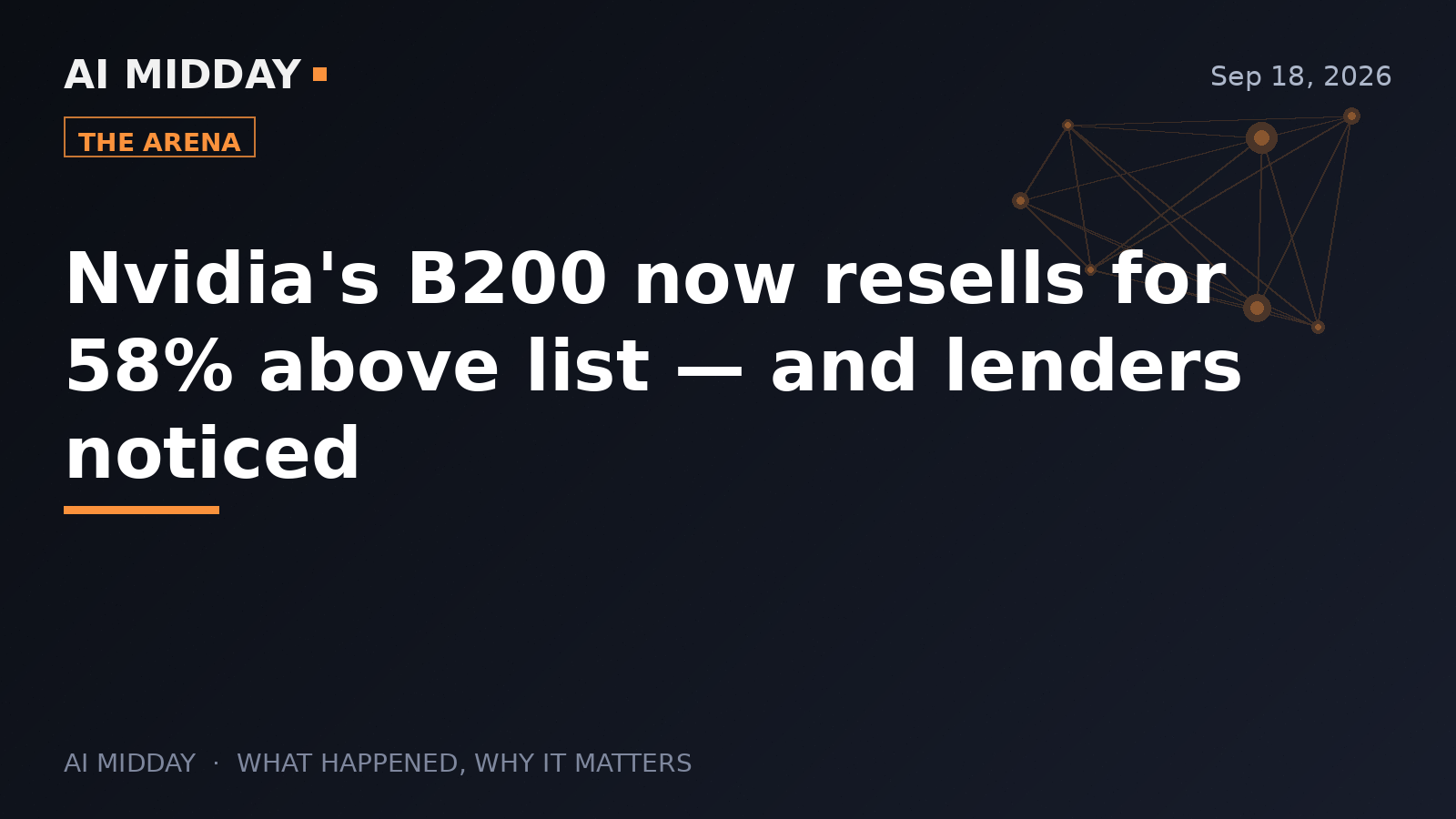
Nvidia's B200 now resells for 58% above list — and lenders noticed

A year-old AI accelerator is appreciating like real estate, not like a graphics card. That changes what gets borrowed against it — and what it says about the shape of the boom.
Nvidia's B200 is trading at 158% of its launch price roughly a year after it reached mass availability, according to Silicon Data's analysis — an accelerator that added 58% instead of shedding the 20% to 40% that standard depreciation schedules assume. Older A100s and H100s are also running well above what three- and five-year straight-line schedules would imply. The cause is scarcity, not sentiment: HBM3E memory is short, fresh allocations are expensive and slow to land, and buyers keep bidding for units already sitting in racks rather than waiting in line. The unit economics back it up — the B200 runs R1-class inference at roughly $0.20 per million tokens and 76 tokens per second per user, so the asset keeps earning while it ages.
Why it matters: an asset that holds its value and produces metered, billable output is exactly what lenders look for, so GPU fleets are increasingly financed against their resale value the way aircraft are, instead of written down like IT gear. That is the same logic behind Nvidia backs $500B data center deal with GPU value guarantee, and it cuts both ways. Used hardware priced at or above new hardware erases the margin advantage secondhand buyers used to count on, and CFOs lose the write-downs they once planned around. The one thing that could break the curve is a fast HBM4 ramp, and TrendForce does not see memory relief arriving before late 2027.
Moonshot AI launched Kimi Finance, a packaged financial-industry stack, and named the institutions already running it: ICBC, CITIC Construction Investment, CICC and E Fund, with dozens more in the programme. The pitch is specific — more than 10 authoritative data sources wired in through MCP (Wind, East Money, S&P Global, Cailianshe, Caixin Data), nine finance skills, five compliance and safety measures, and institutional-grade modeling and report delivery. The nine skills are named workflows, not vague capability claims: institutional financial modeling, research reports, institutional decks, financial-chart generation, earnings commentary, consensus maps, portfolio review, position morning briefs and an HK IPO lens.
The pilot numbers are the part worth reading twice. With CITIC Construction Investment, Moonshot built a trustee-report agent that has run across more than 50 issuers and 100-plus outstanding corporate bonds, producing over 60 reports; per-report handling time fell from about 30 minutes to 10, and human input dropped 67%. Integration work that was scoped at two months finished in three working days. Elsewhere the company reports financial modeling dropping from five to seven person-days down to half a day to one, and industry deep-research cycles compressing from 10–20 days to about two.
Why it matters: a model vendor shipping a vertical stack turns the data terminal from a prerequisite into a competitor, and the incumbents' moat was always distribution rather than the models. Financial institutions are also the most reluctant buyers of anything that can leak data or hallucinate a number, so a named list of banks and brokerages is a bigger signal than any benchmark score.
What to watch: whether B200 residuals survive the HBM4 ramp, and whether Kimi's finance deals convert into disclosed production seats rather than pilot logos.
If the hardware keeps gaining value, should the labs be buying compute or borrowing against it? Tell us in the comments.