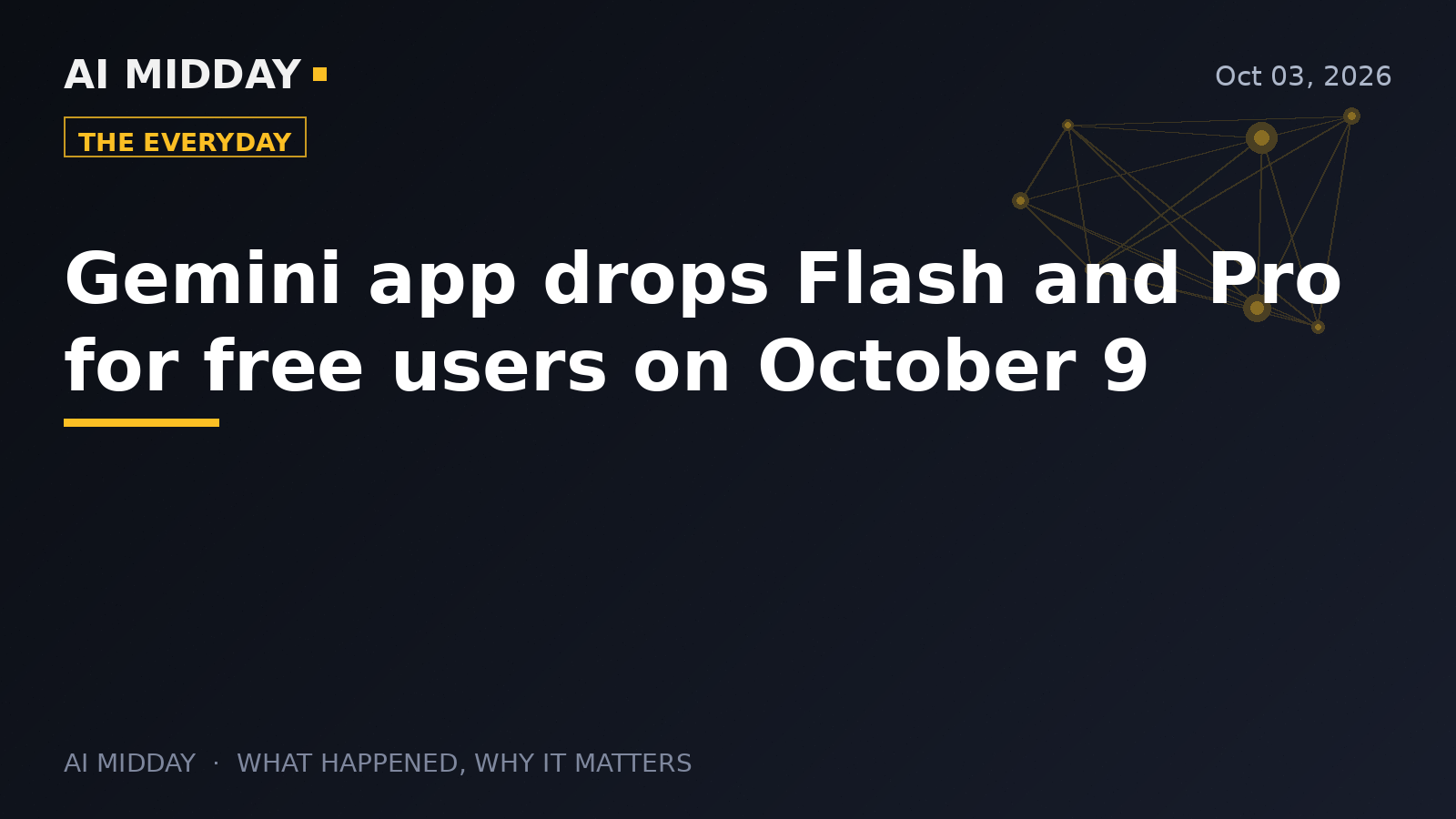
Gemini app drops Flash and Pro for free users on October 9
Google is pulling its best models behind a subscription next week, arXiv is rationing submissions against the AI paper flood, and a DeepMind essay is picking a fight with the singularity itself.
Starting October 9, Gemini app users without a subscription lose access to both Flash and Pro — free accounts will be left with Flash-Lite only. Google confirmed the change in its own help pages this week, and the model table it publishes draws a hard line: Flash and Pro sit behind the AI Plus tier, meaning even paying Plus subscribers lose Pro, while only the AI Pro plan and above keep the full lineup. The restrictions "start to take effect for users without an AI subscription on October 9th," and they stack on top of the compute-based usage caps Google introduced in May, which already throttle how much any free user can run. One clarification the viral version of this story gets wrong: this is the app, not the API — Google's developer pricing page, last updated October 1, still lists Flash and Pro in the free tier, so builders keep their no-cost access while consumers lose theirs. Why it matters: the world's largest consumer AI app is about to turn its free tier into a showcase for its smallest model, and a paid mid-tier subscription now ships without a flagship — the freemium ladder is being pulled up from the bottom, six days before anyone can react to it.
arXiv is capping every researcher at two submissions a month, and the record flood of papers is the reason. In an October 1 blog post, the preprint server said September 2026 brought 40,363 submissions — double the 20,569 of September 2024 — generating roughly 9,000 support tickets in a single month, with the cs.AI category growing more than sixfold in two years. Under the new policy each submitter gets two papers per calendar month across all categories and no more than three active at once; rejected papers still count toward the quota, and arXiv is explicit that the rule is a stopgap. Thomas Dietterich, chair of arXiv's editorial advisory council, said a small share of authors flooding the queue with low-quality work is consuming a disproportionate share of moderators' time, delaying everyone else's papers by days or weeks. We covered the funding shakeup behind the same strain last month — arXiv just funded its independence — as AI floods its queue. Why it matters: arXiv is where AI research gets announced first, and throttling it is the first real supply-side constraint the slop wave has run into.
Three senior Google and DeepMind figures argue in a DeepMind Institute essay that the singularity is the wrong story — intelligence, they say, will arrive as a society, not a solo act. Benjamin Bratton, Blaise Agüera y Arcas and James Manyika, published September 24 and surfaced by The Decoder this week, contend that AGI will emerge from cooperative interaction among models, tools, institutions and human participants — which reframes alignment as an ongoing negotiation rather than a fixed set of values imposed from above. The institute is careful to note the essay does not represent Google's official view. Two preprints back the argument: one casting the next intelligence explosion as a network rather than a single silicon brain, another finding that reasoning models such as DeepSeek-R1 and QwQ-32B develop multi-perspective debate patterns during training when rewarded only for accuracy. Why it matters: if the essay is right, the governance question stops being "how do we control one superintelligence" and becomes "how do we design the institutions that thousands of agents operate inside."
What to watch: whether Google extends the October 9 model cuts to the API — the pricing page is the only thing standing between free developers and the same downgrade.
If the free tier of the biggest AI app is now a single lite model, is freemium AI over — or just entering its paid-only era? Tell us in the comments.