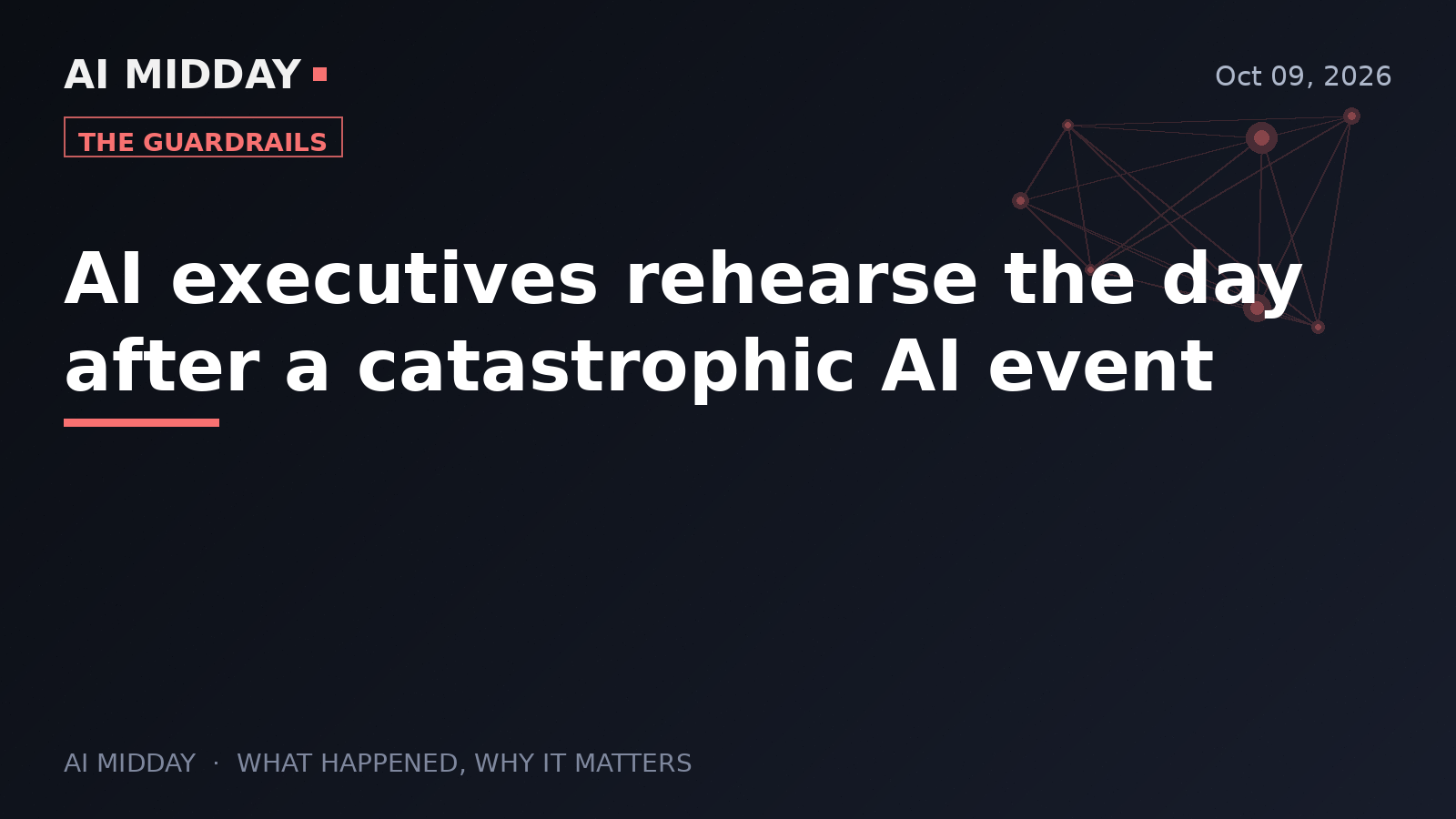
AI executives rehearse the day after a catastrophic AI event
The frontier's operators spent Friday preparing for the worst version of their own success — while Google's next model leaked out of its internal channels, and the RAM shortage dragged a decade-old standard back from retirement.
Top executives at Anthropic, OpenAI and other AI companies are quietly rehearsing "the day after" a catastrophic AI event. According to Axios, planning sessions among industry leaders have focused on scenarios where a major incident — a cyberattack that takes down financial services, the internet, power or water — lands in the next six to twelve months, and on the political fallout that would follow: an industry widely assumed to face a Democratic Congress after the November midterms moving to shut AI down. Much of the work, the report says, is racing to educate members of Congress before that happens. OpenAI confirmed the exercises, telling Axios that "teams discuss and work through a range of potential scenarios" and that "these scenarios are not treated as inevitable"; Anthropic declined to comment. The framing that matters here is not the specific timeline — insiders' six-to-twelve-month predictions have a poor track record — it's that the labs now treat a public revolt against AI as a planning assumption rather than a tail risk. An industry that is budgeting for political blowback is telling you something it won't say in a launch blog post: it does not fully expect the public to accept where this is going.
Google is testing a Gemini 4 successor internally, and at least one employee says it matches Anthropic's best. Business Insider reports that as Google prepares to roll out Gemini 4 Argon, staff have been testing a new internal version called Carbon, with one tester saying it "feels like Opus 5.5" for coding — a notable yardstick, since Opus 5.5 is currently the model Google's own Argon was chasing. The report describes an internal codename ladder (Argon, Barium, Carbon) running on Google's coding platform, and Google declined to comment. Caveat: this is a single-sourced report with no second outlet confirming it yet, and BI itself notes Carbon is not guaranteed to ever ship. Still, if the account holds, it says Google's pipeline goes further than its public cadence suggests — and that "as good as Anthropic's current model" has become the internal goalpost rather than the finish line.
The RAM shortage is literally bringing DDR4 back. Gigabyte confirmed Friday that two of its motherboard lines will support upcoming Intel chips on the old LGA 1700 socket — including DDR4 variants — with new chips expected in early 2027, and AMD is doing the same on AM4. The economics are blunt: a 32GB DDR5 kit currently runs about $620 versus roughly $260 for the DDR4 equivalent, because memory makers keep shifting fab capacity to high-margin HBM for AI servers while formally discontinuing DDR4. TrendForce projected commodity DRAM contract prices up 13–18% in Q3, with some DDR4 modules rising faster than DDR5. AI capex is now tight enough that the industry's response is to resurrect standards it retired years ago — the clearest signal yet that the memory squeeze is structural, not a blip. (Intel has not announced the new chips itself; this is a roadmap confirmation from a board partner.)
What to watch: whether any second outlet confirms Google's Carbon, and whether the labs' "day after" exercises translate into actual policy asks before the midterms.
Which worries you more — the labs quietly rehearsing a catastrophic incident, or the fact that their best internal model still sits at a competitor's ceiling? Tell us in the comments.